Project Showcase: Pioneering iTV E-Commerce – Astro TV Coupon System via DVB-S & EMV Smartcards
An end-to-end Interactive TV (iTV) commerce platform developed in the early 2000s for Astro Malaysia, bridging satellite broadcasting, embedded smartcard hardware, and physical retail Point-of-Sale (POS) systems.
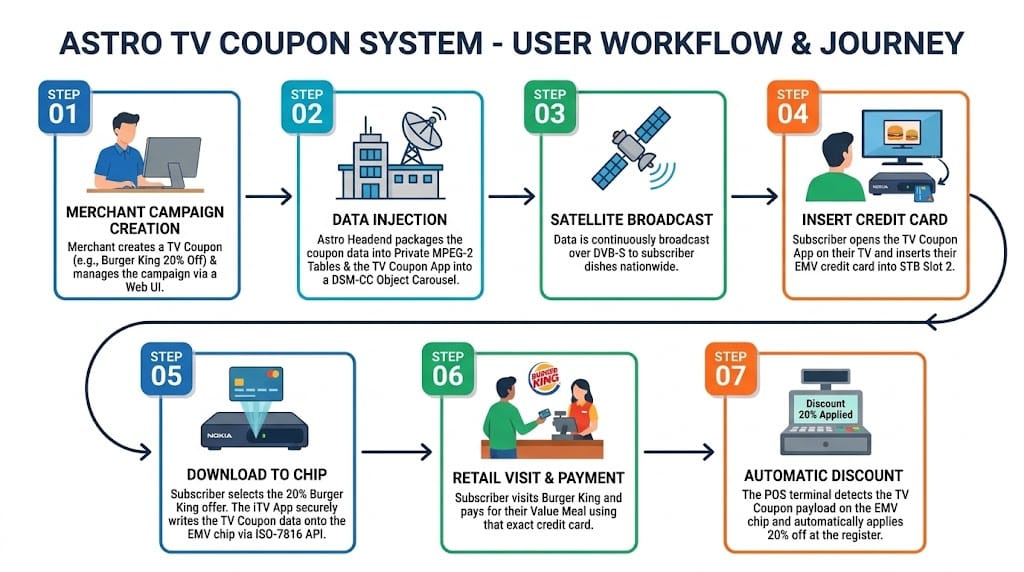
The Concept & User Journey Working closely with Astro’s Product and Marketing teams, I engineered the "Astro TV Coupon" application to transform the television into a direct-to-consumer e-commerce portal. Leveraging the secondary smartcard slot on the Nokia Digital Multimedia Terminal (STB), the system allowed subscribers to download promotional offers directly to their EMV-enabled credit cards.
For example, a subscriber could insert their physical credit card into the STB's second slot, open the Astro TV Coupon UI on their television, and select a "20% off Value Meal" offer from Burger King. The STB would securely write this digital coupon onto the EMV chip. When the user subsequently visited Burger King and paid using that exact credit card, the physical POS terminal would read the EMV chip, detect the downloaded TV Coupon payload, and automatically apply the 20% discount to the transaction—with zero manual input required from the cashier.
Technical Architecture & Implementation Delivering a seamless offline-to-offline (O2O) digital coupon experience over a unidirectional satellite broadcast required a highly orchestrated architecture spanning broadcast engineering, fintech, and embedded middleware.
- Canal+ MediaHighway & DSM-CC Delivery: The Astro TV Coupon application was developed using Canal+ MediaHighway (MHW) interactive middleware. Because DVB-S is a one-way broadcast medium, the executable application files, UI assets, and application lifecycle logic were continuously broadcast in a loop using the standard DSM-CC (Digital Storage Media Command and Control) Object Carousel. The STB tuned to the specific frequency, extracted the carousel data, and booted the MHW application into the virtual machine.
- Proprietary Data Transmission (Private MPEG-2 Tables): To ensure the coupon inventory remained dynamic and lightweight without requiring constant application updates, the actual coupon data (merchant IDs, discount values, validity periods) was serialized and transmitted as Private MPEG-2 Tables. The MediaHighway application was programmed to parse these specific Packet Identifiers (PIDs) in the DVB-S transport stream, dynamically populating the TV UI with the latest merchant offers in real-time.
- EMV Smartcard Integration (Hardware Layer): The application utilized low-level hardware APIs to address the Nokia STB's secondary ISO-7816 smartcard slot. Upon user selection, the MHW application communicated securely with the credit card's EMV chip to write the specific promotional flag/token into a designated applet space, turning the credit card itself into the data carrier.
- Merchant Web Portal & Multiplexer Injection: I provided a Web UI for participating merchants to manage their campaigns. When a merchant (like Burger King) created a new TV Coupon, the backend system compiled this campaign data into the proprietary MPEG-2 table formats and injected them directly into the Astro broadcast multiplexer at the headend, instantly pushing the new offer to millions of STBs nationwide.
- POS Terminal Integration: On the retail side, the participating merchants' POS terminals were updated with logic to query the specific EMV applet space during the payment handshake. If the valid Astro TV Coupon flag was detected, the POS applied the business logic (e.g., deducting 20%) before authorizing the final financial transaction with the acquiring bank.
Engineering Impact This project was years ahead of its time, effectively executing a closed-loop, data-driven retail marketing campaign without the existence of smartphones or mobile internet. By creatively combining the bandwidth of DVB-S MPEG-2 private tables, the interactive capabilities of MediaHighway, and the secure storage of EMV credit cards, the architecture entirely bypassed the need for an interactive return path (like a dial-up modem) on the STB. The credit card physically carried the data from the living room to the retail store, pioneering a frictionless omnichannel experience.
Part 1: Technical Architecture Diagram
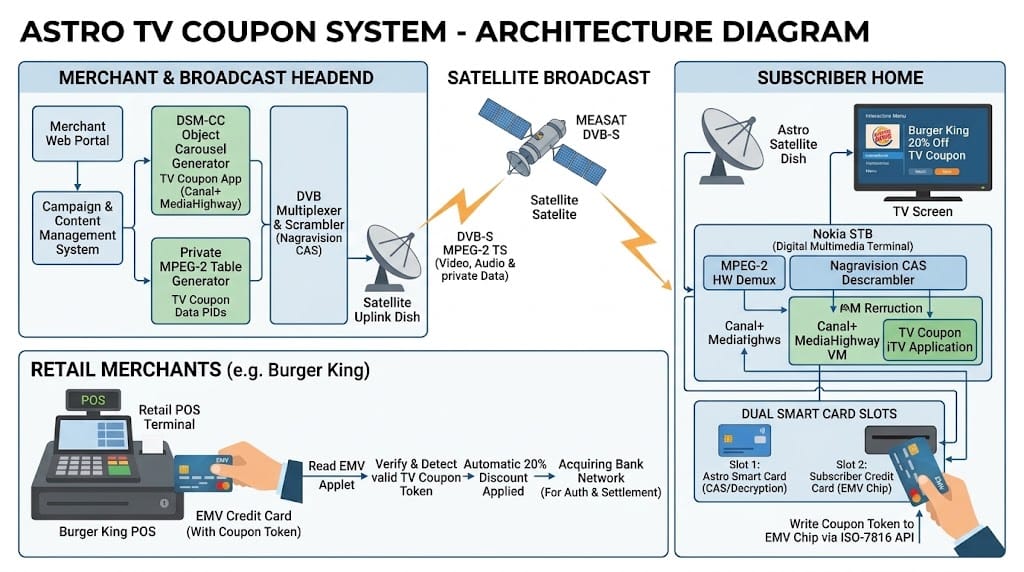
This diagram highlights the end-to-end data pipelines and physical infrastructure that powered the platform:
- The Headend: How the private MPEG-2 tables and the Canal+ MediaHighway iTV application were injected and multiplexed at the transmitter.
- The STB Dual Slots: How you addressed the Nokia STB’s second smartcard slot (ISO-7816) to interface directly with the EMV credit card while leaving the primary slot dedicated to Nagravision access.
- The Retail Edge: The disconnected offline decryption and coupon detection logic loaded on participating POS terminals (such as Burger King).
Part 2: User Workflow & Journey Diagram
This step-by-step diagram details exactly how a user discovered, acquired, and redeemed their offline TV coupon:
- Creation & Broadcast (Steps 1–3): Creating campaigns through the merchant Web UI and broadcasting them continuously over the MEASAT DVB-S satellite feed.
- In-Home Activation (Steps 4–5): The user launching the interactive app, inserting their credit card, and having the custom STB software write the coupon payload directly onto the physical EMV chip.
- Retail Redemption (Steps 6–7): The user carrying the hardware-encrypted card to physical retail registers (e.g., Burger King), where a customized terminal hand-shaked with the card, validated the token, and automatically calculated the 20% discount on their meal.