Project Showcase: Hospitality IPTV & DVB-T Middleware Stack
A comprehensive client-side software stack engineered for hotel set-top boxes, seamlessly integrating terrestrial broadcast RF tuning, IP multicast live streaming, RTSP video-on-demand (VOD), and local media playback under a unified remote-controlled GUI.
The Challenge
Hotels and hospitality operators require a robust in-room entertainment system that can aggregate free-to-air terrestrial broadcasts (DVB-T) and deliver high-definition IP-based content (live channels and video-on-demand) over the hotel's local area network (LAN/Ethernet). Off-the-shelf commercial middleware solutions are often bloated, expensive, and tightly bound to specific hardware vendors. The objective of this project was to build a lightweight, flexible, and high-performance middleware SDK and graphical user interface from the ground up, optimized for resource-constrained set-top box hardware deployed across hundreds of hotel rooms.
Core Architecture & Technical Stack
The solution was structured into two primary layers: a Middle Layer SDK for hardware abstraction and stream management, and a GUI Layer optimized for guest interaction.
1. Middle Layer SDK & Tuner Management
- DVB-T Hardware Abstraction: Developed low-level integration drivers to manage onboard DVB-T tuners, handling frequency scanning, signal lock acquisition, and parsing Transport Streams (TS) for live terrestrial channels directly into the system.
- IPTV Multicast Engine: Implemented IGMP (Internet Group Management Protocol) client logic to manage multicast group joins and leaves, allowing the STB to stream dozens of live IP channels efficiently across the hotel's backbone switch infrastructure without flooding network bandwidth.
- RTSP Client & VOD Integration: Engineered an RTSP (Real-Time Streaming Protocol) stack to handle interactive Video-on-Demand (VOD) sessions, supporting trick-play functions (play, pause, fast-forward, rewind) communicating with central streaming servers.
- Local Media Playback: Integrated hardware-accelerated codecs for local MP4 file playback, enabling auxiliary hotel media (such as promotional videos, hotel guides, or localized content) to play smoothly.
2. GUI Layer & Remote Control Engine
- Remote Control Mapping: Built a responsive hardware event dispatcher to process infrared (IR) and RF remote control inputs with zero perceptible latency, crucial for smooth menu navigation in hospitality environments.
- Hospitality UI Framework: Designed a clean, branded graphical user interface tailored for hotel guests—featuring live video windows, Electronic Program Guides (EPG), hotel directory services, and language selection.
Engineering Impact & Vertical Value
By combining DVB-T RF tuning and IP streaming into a unified software stack, this solution gave hotel operators ultimate flexibility. They could mix and match traditional broadcast channels with custom IP-delivered content without needing complex, costly enterprise headend transcoders. The lightweight footprint of the custom SDK ensured fast boot times, rock-solid stability in 24/7 hospitality environments, and an intuitive guest experience.
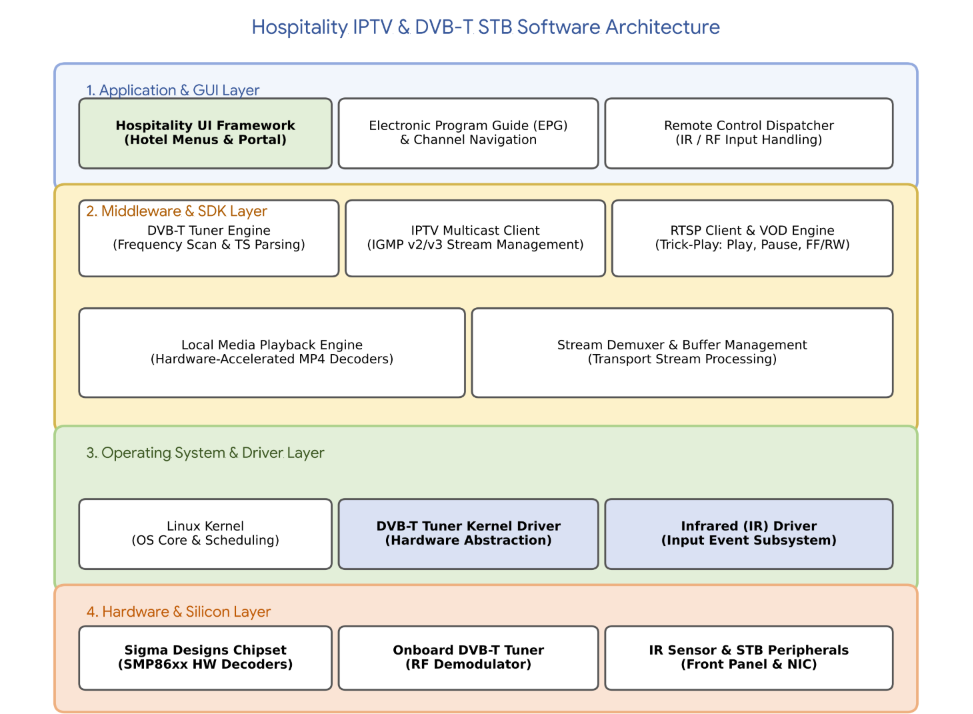
Architectural Layer Breakdown
- Application & GUI Layer (Top):
- Hospitality UI Framework: The guest-facing portal handling hotel directories, language selection, and branded welcome screens.
- EPG & Channel Navigation: Electronic Program Guide rendering for both live terrestrial DVB-T and IPTV multicast lists.
- Remote Control Dispatcher: Low-latency infrared (IR) and RF remote button event mapping.
- Middleware & SDK Layer:
- DVB-T Tuner Engine: Handles frequency tuning, signal acquisition, and Transport Stream (TS) parsing.
- IPTV Multicast Client: Manages IGMP v2/v3 group memberships for efficient live channel distribution across the hotel LAN.
- RTSP Client & VOD Engine: Controls video-on-demand sessions, supporting trick-play functions (play, pause, fast-forward, rewind).
- Local Media Playback & Demuxer: Manages hardware-accelerated MP4 decoding and buffer management.
- Operating System & Driver Layer:
- Linux Kernel: Core process management, memory allocation, and scheduling.
- DVB-T Tuner Kernel Driver: Hardware abstraction layer interacting directly with the RF demodulator silicon.
- Infrared (IR) Driver: Captures raw front-panel sensor pulses and maps them through the Linux input event subsystem.
- Hardware & Silicon Layer (Bottom):
- Sigma Designs Chipset: The core processing unit (SMP86xx series) handling hardware-accelerated video/audio decoding.
- Onboard DVB-T Tuner Hardware: The physical RF receiver front-end.
- Peripherals: IR sensor, front panel LEDs, and Ethernet NIC.