Project Showcase: Proprietary DVB-T IP Data Encryption Architecture
A look back at a legacy broadcast engineering project from the early 2000s, delivering secure live streaming over terrestrial RF networks before the era of modern cloud architectures and hardware-accelerated cryptography.
The Challenge Twenty years ago, Mediacorp needed a highly secure, reliable method to broadcast live horse racing feeds to seven remote Singapore Turf Club (STC) outlets. The standard industry approach at the time was to deploy a DVB Conditional Access System (CAS) and SimulCrypt. However, traditional CAS architectures were notoriously complex and prohibitively expensive for a targeted, localized deployment. We needed a cost-effective alternative that could secure a continuous live stream over a unidirectional DVB-T network without introducing latency or requiring expensive DRM licensing.
The Solution: IP over DVB (MPE) with Hardware-Tied Driver Encryption To bypass the traditional CAS costs, I engineered a proprietary encryption architecture using IP over Digital Video Broadcasting, leveraging Multi-Protocol Encapsulation (MPE). By pushing the cryptography down to the Windows kernel network driver layer and tying it to physical hardware tokens, the DRM was completely decoupled from the application layer.
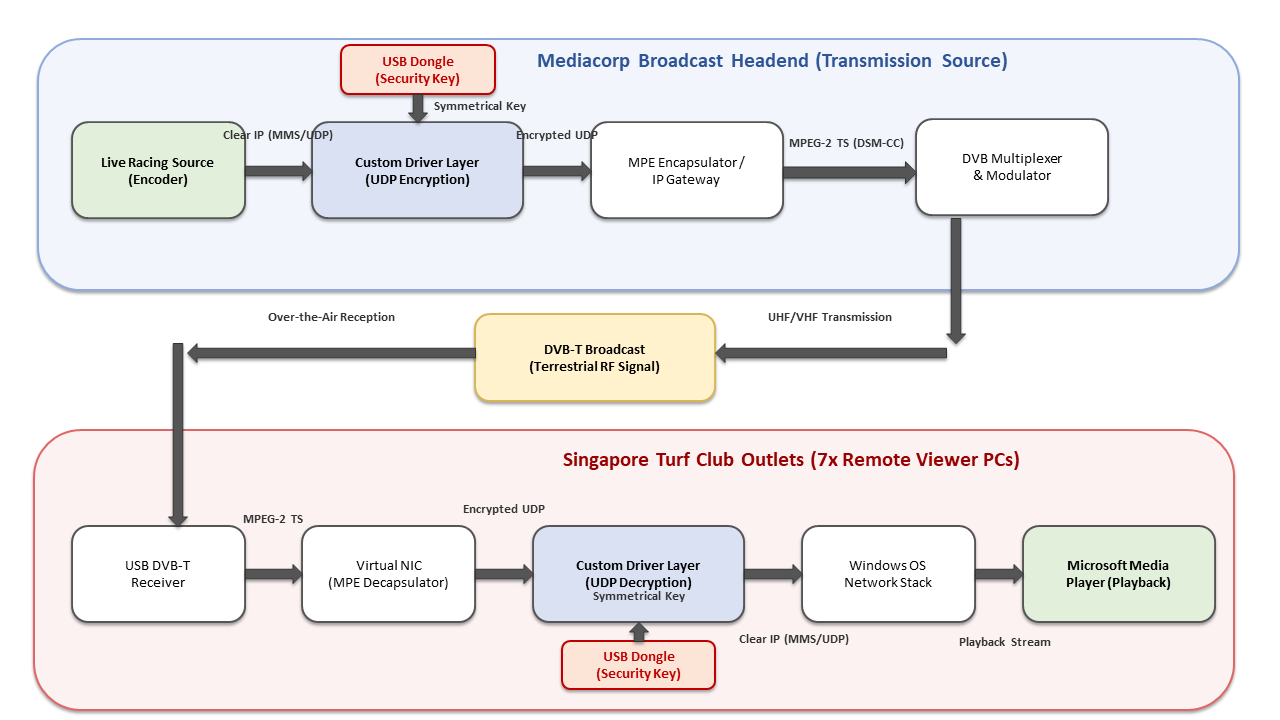
Architectural Flow
- Mediacorp Broadcast Headend (The Source): The live racing feed was encoded into standard IP packets using the Microsoft Media Server (MMS) protocol over UDP. Before these packets hit the broadcast multiplexer, a custom intermediate driver intercepted the clear UDP stream. It applied line-rate symmetrical encryption, authenticated in real-time against a localized physical USB security dongle. The encrypted UDP stream was then routed to an MPE Encapsulator, packaged into DSM-CC sections within an MPEG-2 Transport Stream (TS), and transmitted over the air via UHF/VHF DVB-T.
- Singapore Turf Club Outlets (The Edge): At the seven remote viewing sites, standard Windows PCs equipped with consumer-grade USB DVB-T receivers captured the terrestrial RF signal. A custom virtual Network Interface Card (NIC) decapsulated the MPEG-2 TS to extract the encrypted UDP packets.
- Decoupled Decryption: A paired custom decryption driver intercepted the incoming stream. It continuously polled a local USB security dongle attached to the PC. As long as the physical key was present, the driver decrypted the UDP payload on the fly and passed the clear IP packets to the standard Windows OS network stack. Microsoft Media Player simply listened to the local port and played the live stream seamlessly, entirely unaware of the complex RF and cryptographic layers operating beneath it.
Engineering Impact & Constraints Overcome Executing this architecture in the Windows XP/2000 era required overcoming severe technical constraints. Developing kernel-mode NDIS drivers to handle continuous stream decryption meant that a single memory leak or race condition would result in a Blue Screen of Death (BSOD) at the viewing outlets. Furthermore, without modern AES-NI hardware acceleration on the CPUs, performing continuous line-rate symmetrical cryptography on single-core processors had to be painstakingly optimized to prevent CPU max-out, jitter, and dropped frames.
Because DVB-T is a one-way broadcast medium, there was no TCP return path to request lost packets. The custom cryptography implementation was engineered to maintain cipher synchronization even when inevitable RF interference caused dropped UDP packets.
Ultimately, this hardware-tied approach provided absolute physical security—removing the USB dongle instantly halted packet decryption, cutting off the feed—while saving Mediacorp the immense capital expenditure of a legacy broadcast CAS setup.